THE PENTAGON — Pentagon officials unveiled a new suite of technologies this week designed to prevent Defense Secretary Pete Hegseth from ever seeing an overweight general officer, following his declaration that their physical appearance was “completely unacceptable.”
“It's completely unacceptable to see fat generals and admirals walking the halls of the Pentagon or leading commands around the world,” Hegseth said during a recent address to senior leaders.
According to officials, those comments triggered one of the fastest acquisition efforts in recent Defense Department history.
“The Department has a long tradition of taking senior leadership both seriously and literally,” Chairman of the Joint Chiefs Gen. Dan Caine said. “Within hours we had authorized emergency no-bid contracts for anything capable of preventing the secretary from seeing overweight O-7s and above.”
The centerpiece of the effort is a new augmented reality system known as Petey Rays, a modified version of the Ray-Ban Meta smart glasses.
Using facial recognition software tied to classified personnel databases, the glasses automatically identify general and flag officers before digitally reducing their waistlines until they appear “within standards.”
“The software doesn't actually make anyone thinner,” a Meta spokesman explained. “It simply replaces reality with one that's more consistent with the secretary's expectations.”
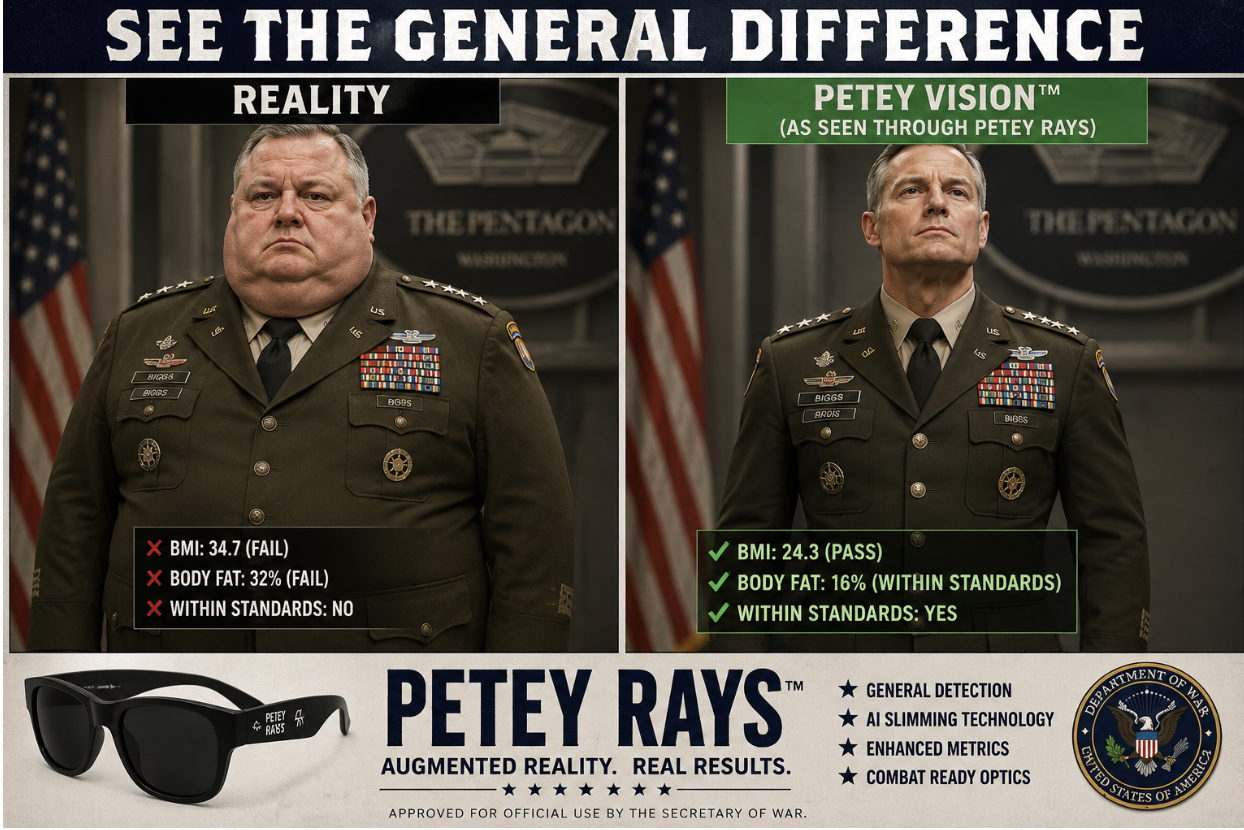
Following initial testing, each military service reportedly updated its height-and-weight procedures to require personnel screening general officers to wear Petey Rays throughout the evaluation.
“The glasses don't just slim the general,” the spokesman said. “They also adjust the measuring tape, the scale, the body-fat worksheet, and — when necessary — the laws of physics.”
Army Master Sgt. Steve Gannon, who oversees height-and-weight screenings at the Pentagon, said the technology merely automates a process that has existed for years.
“I've been pencil-whipping field-grade officers' weigh-ins since I was a staff sergeant,” Gannon said. “This is great! Now nobody has to lie about what they saw ever again.”
Government watchdogs criticized the program as a remarkable demonstration of the Pentagon's acquisition priorities.
“We've now learned exactly how fast the procurement system can move when the operational problem affects generals,” said George Webb of Accountability and Standards in Action, a nonprofit made up largely of former enlisted personnel.
“They fielded this faster than MRAPs.”
Webb said the new technology was unlikely to improve military readiness.
“But it should dramatically improve the secretary's mood.”
At press time, Pentagon officials confirmed work had already begun on Petey Ears, an AI system that automatically replaces the phrase “that's a terrible idea, sir” with “outstanding initiative.”





CommentOpen to paying subscribers
Discussion is open to paying subscribers
Supporters of the paper take part in the discussion under every story. Contributions appear under the name you give and are read by the desk.